
It's one of the most common questions I get. Usually from someone a week or two in, gritting through the evenings, wondering if it's going to feel like this forever.
The honest answer is: it depends.
Not the answer you were hoping for, maybe. But stay with me — because what it depends on is the whole game. Once you see it, the question mostly answers itself.
First, what a craving actually is
A craving is a habit protesting.
That's it. You've built a pattern over years — a drink at a certain time, in a certain chair, after a certain kind of day — and now you've cut it out of the loop. So it does what any ignored habit does. It calls for attention. It pleads. It tells you something's missing.
That feeling of missing something is the entire mechanism. For a craving to work on you, you have to feel denied. You've a desire, you can't have it, and something in you registers that as loss. No sense of denial, no craving. It's that simple.
Which means a craving isn't proof you're broken. It's proof a habit is still running. Different thing entirely.
It's a question of time and intensity
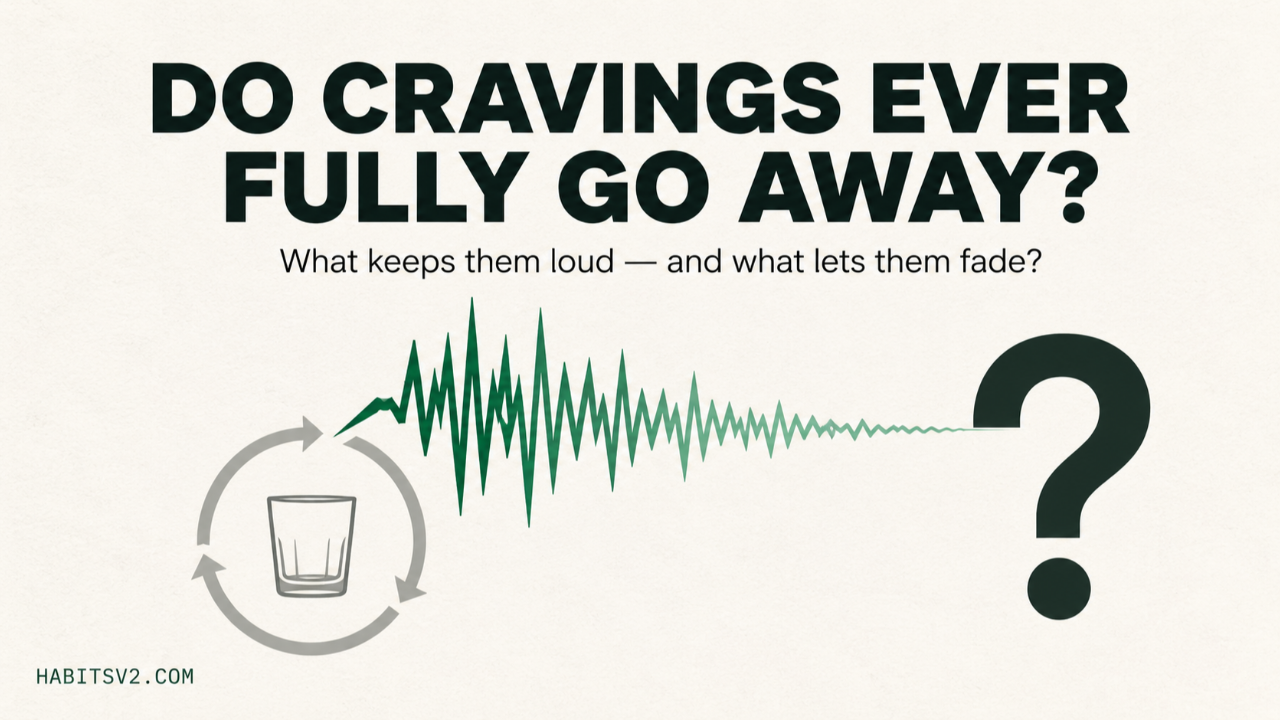
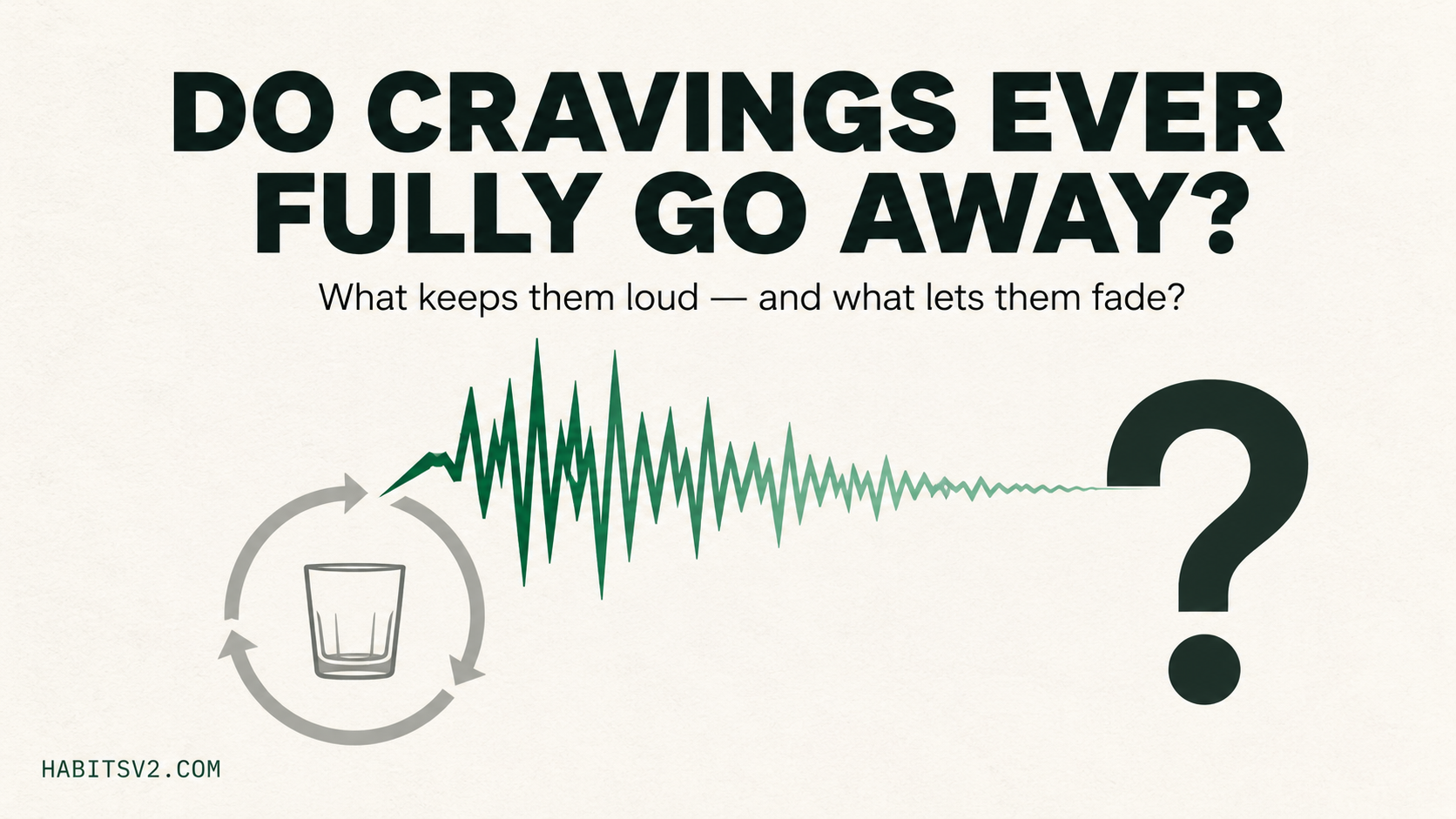
Habits take time to build, and they take time to fade. But here's the good news buried in the timeline: the loudest protests come early, and they're usually the shortest-lived.
The first stretch is noisy because the habit is still fresh, still expecting to be fed. Give it nothing, consistently, and the noise thins out. Not in a straight line — there'll be spikes — but the trend is down. Always down, as long as you're not feeding it.
So when people ask "how long," the real answer is: as long as you keep the habit alive. Which brings me to the part most people never get told.
Weak habits don't roar
Here's the line I want you to sit with: weak habits don't produce strong cravings.
The strength of a craving isn't a measure of how much willpower you lack. It's a measure of how alive the habit still is. A loud craving is a well-fed one. A quiet craving is a starving one.
So if it's roaring at you, that's information. It isn't telling you you're weak. It's telling you the habit still has fuel in the tank.
Which raises the obvious question — where's the fuel coming from?
The two readings
Two people can feel the exact same craving and have completely different experiences of it. The difference isn't the feeling. It's how they read it.
Reading one: This is the demon drink. It's my faulty wiring. This is who I am, and this is my cross to carry — forever.
Reading two: This is a habit protesting. Pleading. Losing.
The first reading hands the craving a story big enough to live inside. You've made it permanent, made it part of who you are, made it bigger than you. Of course it stays strong — you've given it everything it needs to survive.
The second reading starves it. A habit cannot survive being shut down. But it can absolutely survive being fed — and the story you tell yourself is one of the ways you feed it.
How people keep cravings alive
Mostly without meaning to. Two ways I see again and again.
Moderation. The occasional "just one." Every taste tops the tank back up. You've told the habit there's still something worth wanting, and it settles in for the long haul, waiting for the next opening.
Quitting forever — in short bursts. A hard week, a cave, a restart. Another hard week, another cave. Each round drives the deprivation loop harder. You're not weakening the habit; you're strengthening the very thing that makes it hurt — the sense of being denied something you still want.
Both keep you exactly where you don't want to be: still wanting.
What cravings actually become
Here's where it ends up, long term. Cravings don't shrink into smaller, cuter demons. They become stupid thoughts.
You'll be standing somewhere ordinary and the thought will float up — a drink would be nice — and instead of a war, there's a flat little no, it wouldn't, and it's gone before you've finished the thought. No weight. No pull.
And here's the quiet truth: they were stupid thoughts at the beginning too. You just couldn't see it yet. The thought hasn't changed. Your relationship to it has.
So — do they go away?
For me, yes. Fully.
Not because I'm strong, not because I'm holding a line by my fingernails after all these years. Because I've no desire for the cheap buzz anymore. I know exactly what it costs, and there's nothing there I want. You can't crave something you don't want.
That's not a place you fight your way to. It's a place you see your way to. You stop feeding the habit, you stop telling yourself the big permanent story, and you let the thing go quiet.
It does go quiet. Give it time, stop topping up the tank, and the noise fades to nothing.
Stop the flow. Do the work. Move on.
Onwards and upwards,
Kevin
