
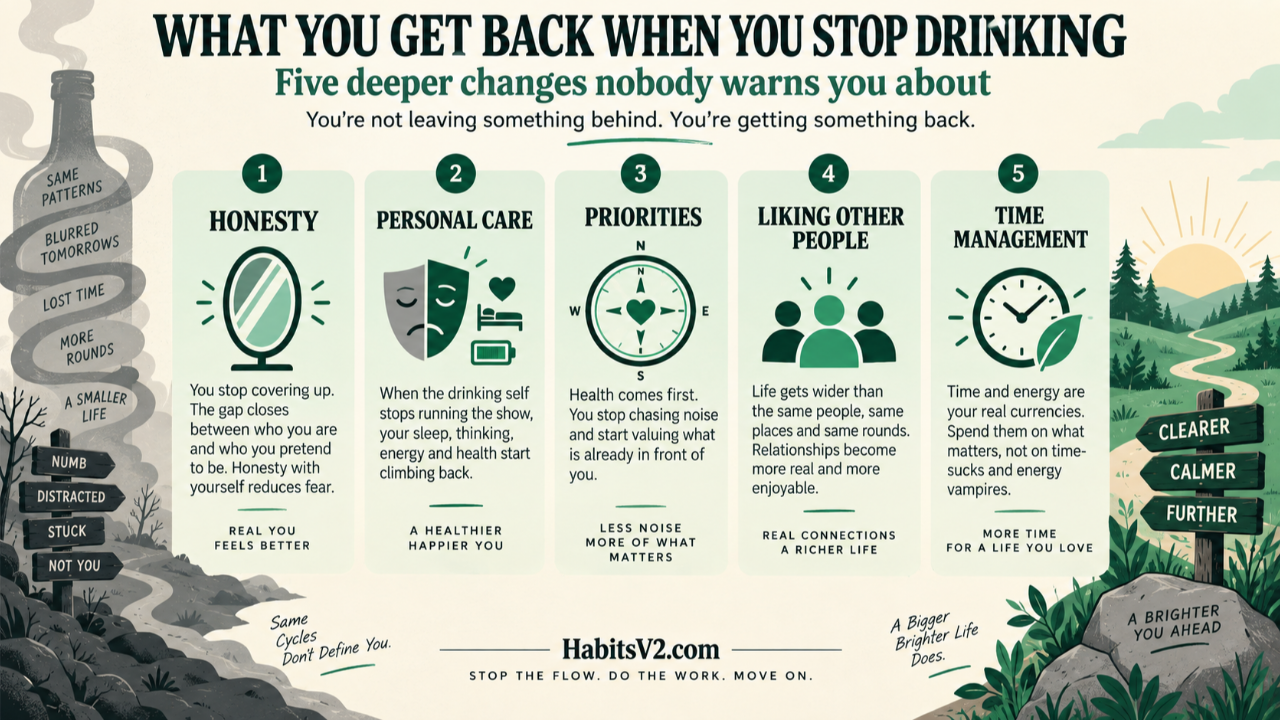
Some of what happens when you stop drinking, you notice almost straight away. Your sleep improves. Your energy comes back. Your mind clears. The physical stuff starts to show up within weeks.
But there's another set of changes that take far longer to unfold — and nobody warns you about them, because you can't see them coming. I certainly couldn't. When I first stopped, thirteen years ago, I didn't think I had a problem in any of these five areas. I was wrong about every one of them.
And I want to say this up front: you're not leaving something behind. You've always left something behind with alcohol. What follows is what I got back.
1. Honesty
I'm not a dishonest person as a rule — and that's exactly the problem. Three of my biggest values are to be honest, to be sincere, and to live with a good heart. So it took me a long time to see that I'd been behaving dishonestly the whole time I was drinking.
Not in the obvious way, deliberately telling lies. It was quieter than that. Covering things up. Not telling the truth about what I was drinking, how much, who with, how long I'd spent in the pub. And most of all, not telling the truth to myself.
A lot of it is self-preservation. You don't want other people to think badly of you, and you really don't want to look in the mirror and think badly of yourself — so you protect your own dignity and self-esteem even as they're falling away, because you don't want to crack the mirror in front of you.
Here's what I found on the other side: honesty with yourself is the single biggest antidote to fear there is. It closes the gap between who you are and who you pretend to be. And once that gap closes, you can get up in the morning and face the day for everything it holds, one bit at a time.
2. Personal care
It's not that I didn't care about myself. It's that I'd handed the wheel to Mr. Hyde.
I always think of the drinking self as Hyde — the character in the story who takes the potion and turns into someone else. I never became a monster. But Hyde is the part of you that reaches for the escape, and his whole job is to push the clock back. To keep you in the moment. To stop you thinking about anything beyond the buzz you can get right now and the things you can forget right now.
The trouble is what that does to the rest of your life. Under Hyde, you've got less energy, because you're burning it on recovery. Less time, for the same reason. And with less time and energy, the problems mount up — and mounting problems bring anxiety, and anxiety eats even more of your time and energy. It's a spiral into not giving a damn, not because you've stopped caring, but because you've no capacity left to care with.
It's slow, so you don't notice it happening. You only notice when it reverses — when your health, your thinking, your sleep and your energy all start climbing back up, and you finally see how far down you'd gone.
I'll be honest: given what I was drinking by the end, I don't think I'd be here now. So I'm grateful to that older version of me for stopping when he did.
3. Priorities
This one is simple to say and hard to learn: your health is the most important thing you have. And it's the thing you throw away drinking — not in one go, but pebble by pebble, so quietly you never clock it. Where the alcohol flows, the damage goes, and it's never just the liver. It's the brain, the heart, the kidneys, the lungs, the blood, the bones. Everywhere.
But priorities aren't only about health. As a drinker, I thought I wanted the big house, the car, the money, the status — a certain kind of growth. I even hoarded knowledge the same way: buying books to have them on the shelf, chasing facts instead of understanding, coming away from a lot of it with either nonsense or the same recycled self-help I'd read ten times before.
These last couple of years I've gone back to reading proper fiction — Dickens, Dostoevsky, and I've just picked up Wuthering Heights again. Not for a fact I can use. For the experience of it. Like a great film you return to again and again.
That's the real shift. As a drinker I was always chasing — dreams, goals, bucket lists, the next place I had to see, never quite present when I got there. What I've realised since is that nearly everything I was chasing was a simple thing that was already right there in front of me.
4. Liking other people
This is a strange one to say, because I've always liked people. But I like them more now than I did when I was drinking.
I come from a large family and I'm close to all of them, so I've never needed a crowd of friends. My mates, for most of my life, were drinkers — and I can't say a bad word about them, they're good people. Stopping doesn't switch off your ability to tell who's decent and who's an asshole. You still know.
The problem was that it was all one-dimensional. Same conversations, same people, same places, same rounds, same four or five or six pints. There's a comfort in that repetition — a handy way to decompress from the working day — but it's narrow. And when you drink alone, which I did plenty of later on, that comes with its own set of problems.
I also got defensive about it. Sensitive to anyone raising a concern. My own father used to say, gently, "watch your liver, be careful how much you're drinking" — and I'd bristle. Who do they think they are? That defensiveness is its own tell.
The beginning without drink was hard, socially. A lot of the people I knew were tied to those situations, and I felt lonely for a while. But I love being around people now, I've got a few friends I genuinely like, and through coaching I've met more people than I ever imagined. I never thought I'd end up any kind of teacher. It's brought me more than I can say.
5. Time management
Not the cliché. I've no interest in getting more stuff done, or piling more money in the bank, or acquiring more of anything.
I think of time and energy as two of the biggest currencies I have. The real question isn't how to squeeze more out of them — it's what's actually worth spending them on. And that only comes once you start re-examining your values and your beliefs, and letting your real priorities rise to the surface.
My guiding measure is contentment. Am I content getting up in the morning? Content with what I do all day? Content going to bed knowing I did what needed doing, and looking forward to getting up and doing it again? Not arriving anywhere — because once you arrive, then what? — but knowing you're on the step you want to be on, with plenty of road still ahead.
So I watch my mind for the drift into nonsense. Social media is brilliant at that: dragging you into things you can do nothing about, making you angry, taking a click off you. Why hand a minute of a finite life to somebody else's buzz?
Instead: be grateful for the simplest things. Someone laid the road so I can drive on it. Someone opened the shop so I can get a pint of milk. Someone brings the coffee over with a smile. Family. A one-minute conversation over a loaf of bread — the kind of nuance you only really feel back home. I'm 60 now, so keeping the quality of life up is a job of work, and it's far easier when you're not only looking after yourself but looking after other people too. It gives the good stuff an outward direction.
Take care of what you spend your time on and who you spend it with. Avoid the time-sucks and the energy vampires. Everyone's unique in this — we all have to find our own pathway. But feeling peaceful gets so much easier once the toxins are gone. And not only the alcohol. All of it.
—
If you want to stop drinking and you'd like real help doing it, the 30-Day Accelerator runs live with four group calls a week, all built around this — leaving alcohol behind as a positive, not a loss.
Stop the flow. Do the work. Move on.
