
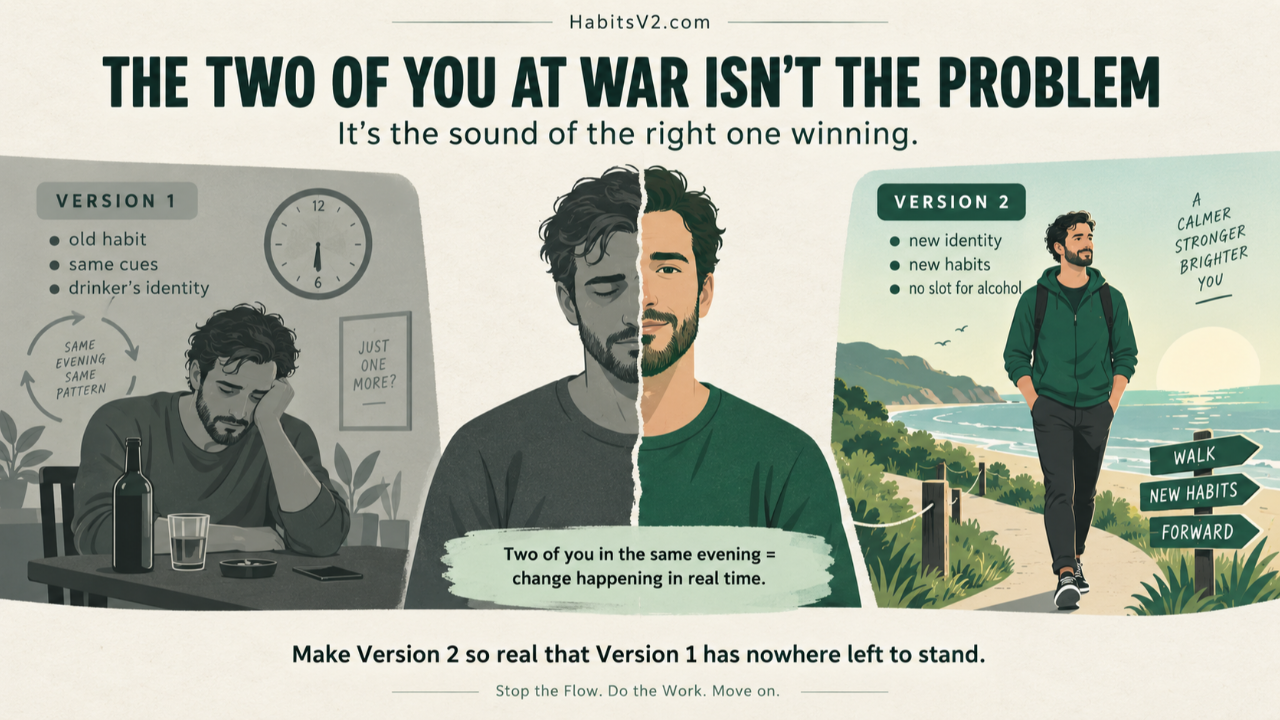
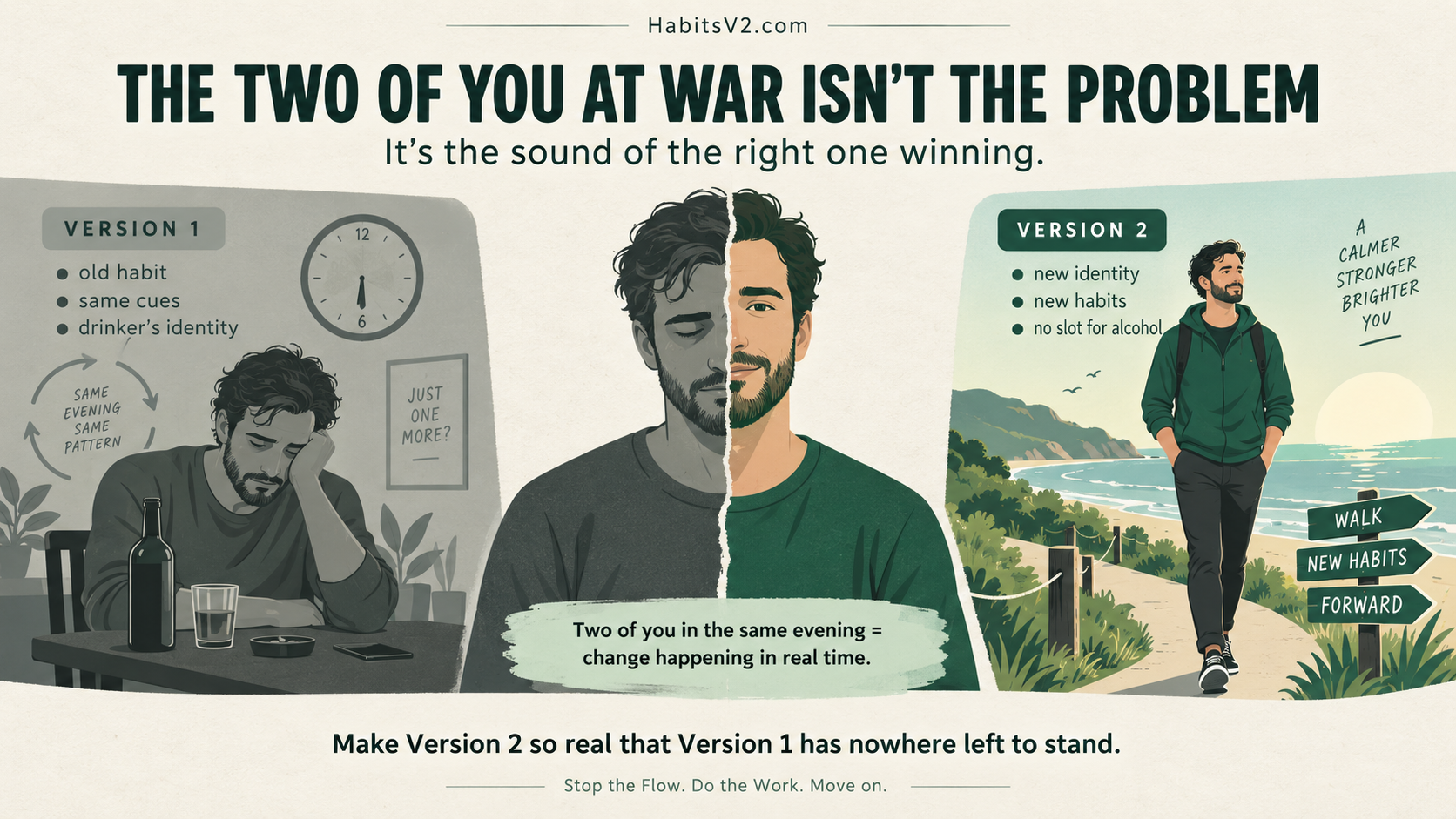
Someone left me a comment saying that giving up drinking felt like living with a split personality. Like there are two of them now — one who wants to drink, and one who doesn't. They meant it as a worry. I read it as the best sign there is.
Because that's the point. That is the thing working.
The one who doesn't want to drink has been there a long time — just under the surface. You didn't build him this week. He's been quietly forming underneath for years, waiting for a slot to stand in. When you stop, he finally gets to speak, and the old self — the one who ran the show — speaks back. Two of you, in the same evening, pulling opposite ways. That's not you failing to change. That's the change happening in real time.
I drank for over thirty years. I loved it — it was my favourite thing, my pastime, what I did with my mates, what I did at the end of the day. It's never a problem until it's a problem. I built a forestry business, moved the family to Spain, rebuilt our whole life out there — and I did all of that in spite of the drinking, not because of it. I wasn't under the influence with a chainsaw in my hands; I drank in the evenings. But those evenings were the other side of my life — the personal side, the body-mind-soul side — and that's where I could have done so much more. That quiet nightly cost is the part you brush under the carpet.
That split you're feeling is the mechanism doing its job. Your life is signalling to you. The habit itself is neutral — it's a system with no morals. Give it good habits and it works for you; give it bad ones and it works against you just as hard. It doesn't care either way. For years mine was pointed at drink, and drink became the fulcrum everything else turned around, family included. That's version one of yourself: an old identity built patiently over most of an adult life.
It's Jekyll and Hyde, and you already know both of them. The upstanding one who wants to get forward, and the one who's convinced he's having a great time — while quietly ignoring every consequence. That was never a story about monsters. It's the split every drinker carries. What's new now is that you're finally on the side of the one who wants to get forward, and he's the one telling the story.
Version two of yourself is the one you build outside all of that. He has no slot for alcohol at all — and here's the strange part: he has no past in that sense either. You can't carry your drinking past across the line with you. A lot of the old ways of thinking and doing just go defunct, because they were wired to a life that's gone. So there's no programming there yet. Your job is to lay down new baseline habits — some you already have and only need to adjust — that walk you toward the place where alcohol is simply nothing to you.
This is why I'd steer you away from the framing that says you're powerless over this and have to wear a label for the rest of your life. It's a habit. And habits are dumb — they run the same sequence every time. Once you see the sequence, they're not hard to take apart.
The real opponent isn't you. There are two people at war inside you, yes — but the opponent is the behaviour. The old habits. The drinker's identity. And that opponent is weak. It feels strong because it's backed by years of a powerful habit, but the moment you break it down, there's nothing solid there. The more determined you are, the more it shows itself for what it is.
So how do you win? You make version two so real that version one has nowhere left to stand. It comes bit by bit — some old skills carried over, some new ones learned. And the first skill I'd have you build is a way out that doesn't involve the drug. Early on the emotions can overwhelm you; the sheer weight of what's ahead can feel scary. When it hits, go for a walk. Do something. I walked for hours — down on the beach, early morning and late afternoon — burning the energy, pointing my mind somewhere useful, getting my perspective back. That walk was version two, being built one step at a time.
And keep this in front of you: you're not getting rid of something. You're moving toward something. The people who do this and come out the far side nearly all land on the same regret — not "that was hard," but "why didn't I do this sooner?" Because they're happy, they're content, and they can see all the hassle they'd have spared themselves.
The two of you at war is not the problem. It's the sound of the right one winning.
Stop the Flow. Do the Work. Move on.
Join our next Acclerator group calls: https://www.habitsv2.com/accelerator
