
Using the Alcohol Habit's Own Wiring Against It
Most people try to stop drinking the hard way. They square up to the habit and try to out-muscle it. Willpower. Gritted teeth. Brute force. White-knuckling their way through every evening and hoping they've got more fight in them than the habit has pull.
You don't have to do it that way. And once you see how the habit actually works, you won't want to — because there's a far easier route, and it runs straight through the habit's own wiring.
The one thing it runs on
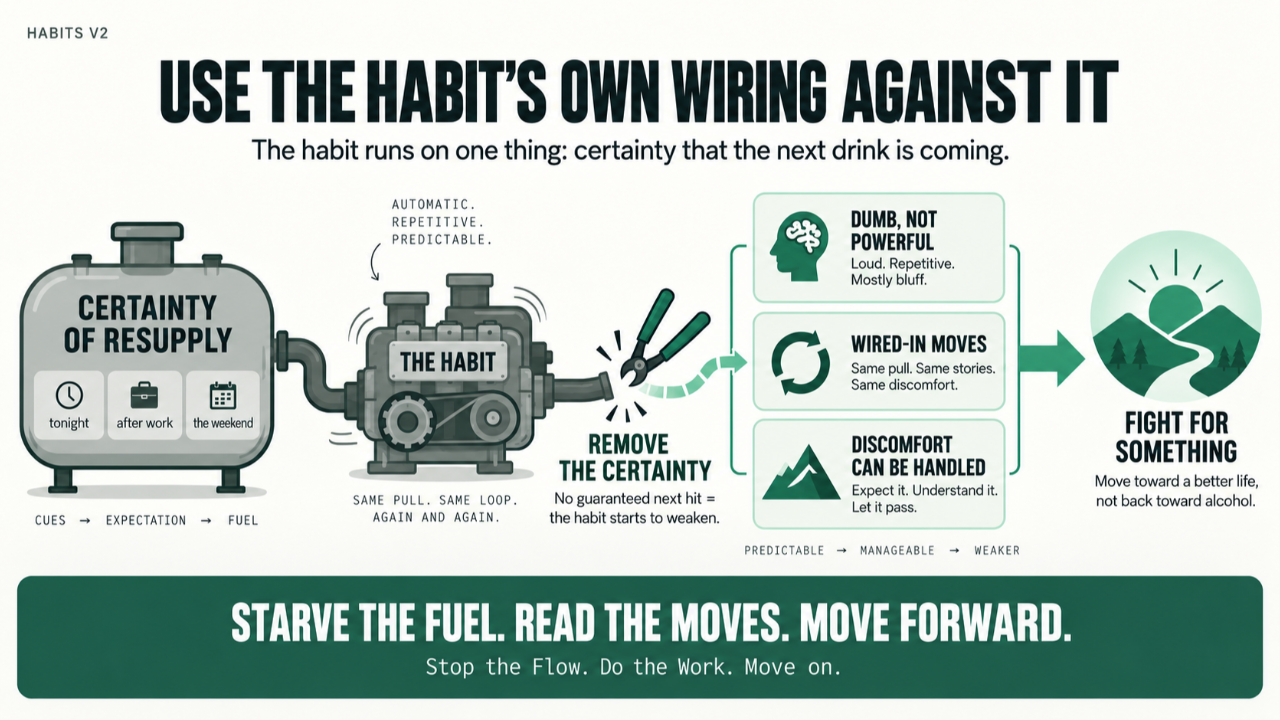
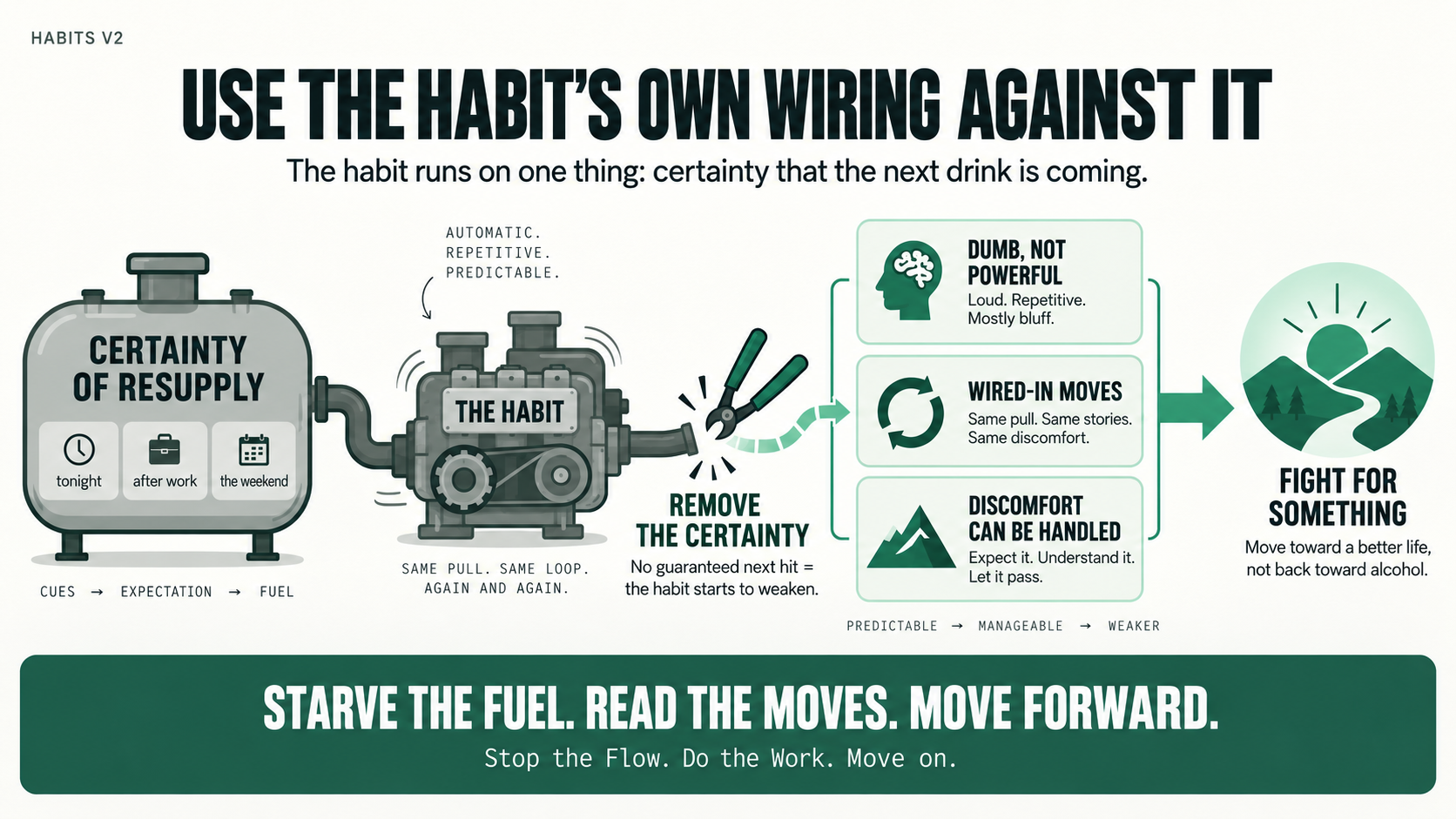
Here's the whole engine, in one line: the habit runs on the certainty that the next hit is coming.
The certainty of resupply.
You always know the next one's on its way — tonight, the weekend, after work. That quiet certainty is the fuel the whole thing burns. It's what lets the habit sit there, patient and confident, because it has never once had to wonder whether it'll be fed.
Take that certainty away and something interesting happens. The habit doesn't get stronger. It starts to come apart on its own. A system that runs on being fed can't survive once the food stops being guaranteed.
The alcohol was never the thing keeping you stuck
This is the part people miss, so sit with it for a second.
The alcohol and the habit are not the same thing.
Alcohol brings its own set of problems, and some of them are genuinely dangerous — that's a separate conversation and one worth taking seriously. But the thing that keeps you trapped, the thing that drags you back night after night, is the habit. And the habit has almost nothing to do with the alcohol itself.
You can tell, because the habit doesn't care what it burns. Its defence will use anything it can get its hands on — your stories, your fear of the future, the way you think about a craving. And if you try to take its fuel away, it'll happily switch to another one. It'll trade the alcohol in a heartbeat if it thinks that keeps the hit alive.
If you don't believe me, look at smokers. Watch how many of them swap cigarettes for vapes without missing a beat. Same habit, same wiring, brand-new fuel. The habit didn't care about the cigarette. It cared about being fed.
Reason one: your habit is dumb
Now the good news, and there are two pieces of it.
The first is simple: knowledge is power, and your habit is dumb.
It only seems powerful. It's been there thirty years, so it feels like a permanent fixture. You've given in to it hundreds of times, so it feels like it always wins. Its defences look enormous. But look closer and they're mostly harmless — noise and bluster with very little behind them. The length of time it's been around isn't strength. It's just repetition. And the damage worth respecting comes from the alcohol, not from the habit throwing a tantrum.
Once you stop mistaking loudness for power, half of its authority is already gone.
Reason two: it's wired in, so it can't surprise you
The second piece is the one that turns everything in your favour.
The habit is wired in. It's automatic. And automatic means it can't step outside itself and ambush you with something new. It has a fixed set of moves — the same pull, the same stories, the same jab of discomfort at the same time of day.
That predictability is a gift. Because once you know the moves, you can counteract them. You're no longer reacting to a mystery. You're watching a machine run through a routine you've already seen a hundred times.
Knowledge is power again. The thing it was counting on — surprise — it doesn't actually have.
What it's genuinely good at
Let's give the habit its due on the one thing it does well: it's very good at creating discomfort. That's its real weapon. It uses our low tolerance for discomfort against us, betting that a bit of unpleasantness will be enough to send us back for the fuel.
So the practical work is about that discomfort — not fighting it, handling it.
Turn down the dial. Use your rational mind to think through the emotion instead of being swept off by it. And you can go further than that: you can simply accept the discomfort, let it be there, tolerate it — because discomfort you understand and expect has already lost most of its bite.
The thing that makes that possible is having somewhere to go.
Fighting for something, not against it
If you've got a target you're moving towards — anything good, anything outside alcohol — then the discomfort stops being pointless. It has meaning. It's the feeling of a machine running low on fuel, which is exactly what you want it to be doing.
That's the whole shift. Stop the flow. Do the work. Move on — towards something better.
You're no longer bracing against the habit, waiting for it to tire before you do. You've stopped feeding the certainty it runs on, you've seen its moves for the dumb, wired-in routine they are, and you've pointed yourself at something worth walking towards.
You're not fighting against any more. You're fighting for.
If you'd rather not do this part on your own, the Accelerator is where I take people through exactly this — how to starve the habit's fuel, read its moves, and build the target that makes the discomfort worth carrying. Details here: https://www.habitsv2.com/accelerator
Stop the Flow. Do the Work. Move on.
